Case Study
Graphwise
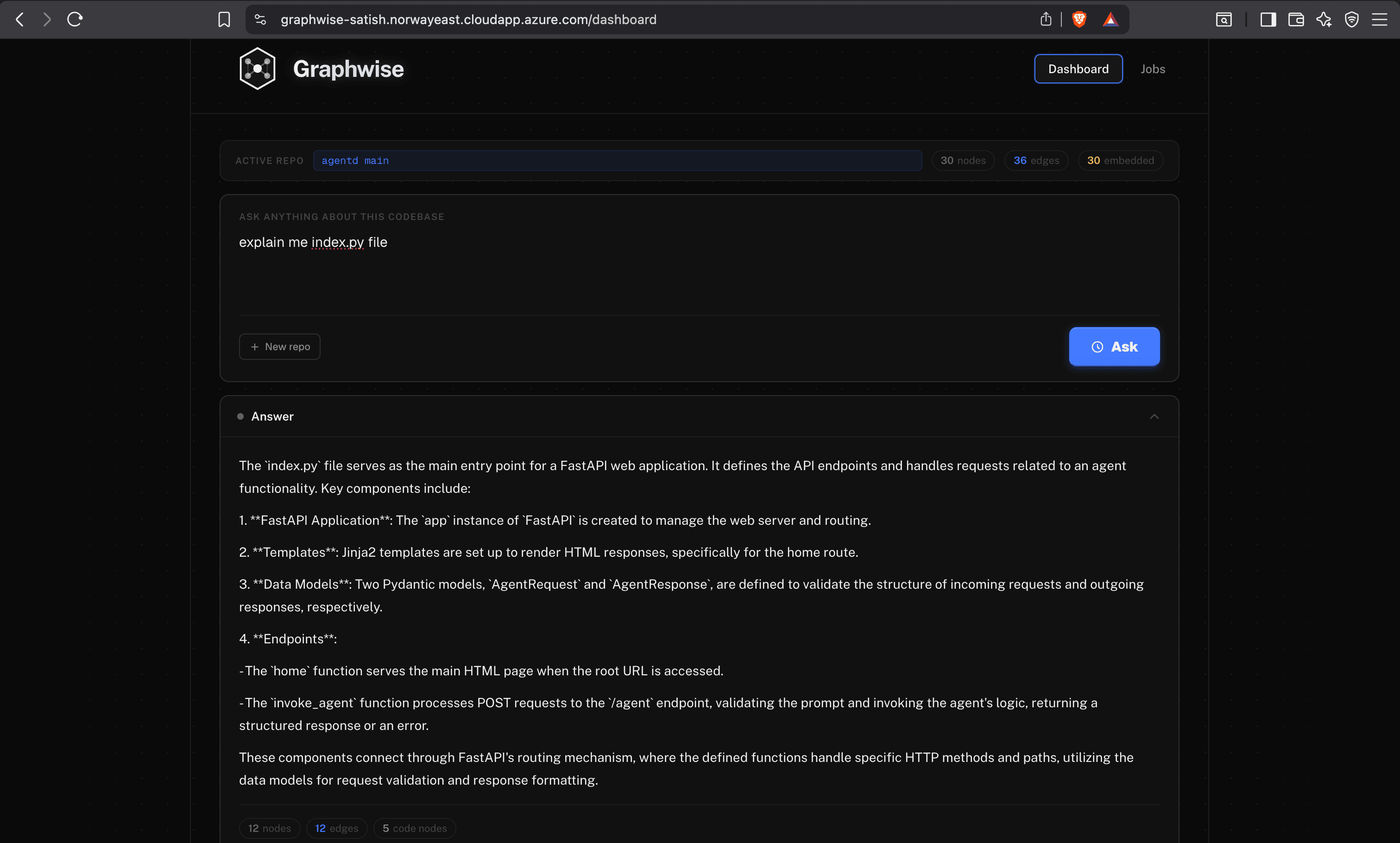
Code knowledge graph platform with GraphRAG: processes repositories, models code relationships in Neo4j, and enables natural-language code search and Q&A.
Visuals
Problem
Understanding a large, unfamiliar codebase is one of the most time-consuming parts of software development. Traditional keyword search misses semantic relationships, you can find a function by name but not by what it connects to. Existing tools either require expensive embeddings for every file or produce flat, context-free results.
Solution
Built a Graph RAG pipeline that parses a repository's AST, extracts entities (functions, classes, imports, modules) and their relationships, and stores them as a property graph in Neo4j. At query time, natural language questions are converted to Cypher traversals, retrieving structurally relevant context before passing it to an LLM, giving answers grounded in actual code topology, not just text similarity.
Impact
- Natural-language code search grounded in actual code relationships, not just embeddings
- CI/CD pipeline with GitHub Actions. Push to main automatically rebuilds and redeploys
What I Learned
- Graph-based retrieval and vector-based retrieval solve different problems. Graph is better for 'what calls what', vectors for 'what does this concept mean'; combining both gives the best results
- Neo4j Cypher generation from natural language is the hardest part. LLMs hallucinate invalid property names; adding a schema-awareness step before generation reduced errors significantly
- Caddy was a much simpler reverse proxy choice than Nginx for this scale. Automatic HTTPS with one line of config